Written by Vardan Patel
Co-Creator & Health and Fitness Content Creator at FitHub 365
Vardan combines his personal experience with exercise and healthy lifestyle habits with research from reputable health organizations and scientific sources to create practical, beginner-friendly health and fitness content.
Key Takeaways
- Dopamine is better understood as a motivation and learning signal than as a “pleasure chemical.”
- The adolescent brain is still maturing, and its reward circuitry is especially responsive.
- Links between heavy social media checking and changes in brain sensitivity exist, but the research shows association, not proof of harm.
- “Dopamine detoxes” can’t lower or reset dopamine. Changing habits and surroundings is what helps.
- Sleep, daily movement and a few small screen-habit changes are the most practical places to start.
How Dopamine Affects Youth Health
Why can a teenager spend three hours on reels but struggle to start ten minutes of revision? Why does a phone buzz feel urgent even when nothing important is waiting? Many people point to one word: dopamine.
Social media is full of confident claims about it, and most of them are oversimplified. This article explains what dopamine does in a young person’s brain. It looks at what research suggests about habits, screens and mood, and what readers can realistically do about it.
Dopamine is not a toxin, and it isn’t only a “feel-good” chemical. It’s a messenger that helps the brain decide what is worth pursuing and what to repeat. Young people are still developing the systems that use it, which is why habits formed in these years can feel so powerful. This is general educational information, not medical advice.
What dopamine actually does
Dopamine is a neurotransmitter, a chemical that carries signals between brain cells. It is involved in movement, attention, learning and motivation. Researchers describe the dopamine system as central to how the brain codes reward and drives approach behaviour. flo
A simple way to picture it: dopamine is less about enjoying the biryani and more about the pull to go and get it. It helps the brain flag something as worth remembering, so you do it again.
That’s why dopamine is in play when a student feels excited before a cricket match, when a notification pops up, and when a long-awaited result finally arrives. The anticipation matters as much as the reward itself.

Why the teenage brain is different
The brain keeps developing well into the twenties. According to one review, the dopamine pathways involved in reward and motivation mature slowly through adolescence. The same review notes that much of what we know comes from animal studies, so human conclusions should be drawn carefully. nih
Adolescence also seems to be a time of strong reward sensitivity. One researcher describes a long-running debate about whether the young brain’s reward centre is overly responsive or under-responsive to rewards, and the evidence is not settled. Brain imaging can only measure activity in a region, not dopamine directly, so scientists are inferring what dopamine is doing. nih
What many experts do agree on is the practical picture. Teens tend to be drawn to novelty, peer approval and quick rewards, while the self-control systems in the front of the brain are still catching up. That combination isn’t a flaw. It helps young people explore, learn and form friendships. It also makes certain products and habits harder to resist.
Screens, social media and the reward loop
Apps are designed around feedback: likes, streaks, notifications and endless scrolling. For a developing brain that is especially responsive to social approval, this can be a strong draw.
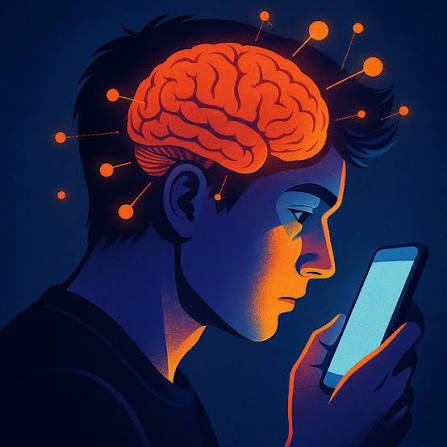
One of the best-known studies on this followed students in rural North Carolina for three years using brain scans. The researchers found that habitually checking social media in early adolescence was associated with changes in how the brain responds to anticipated social rewards and punishments. Among those who checked often, sensitivity to social feedback increased over time. It decreased in those who checked less. ajou
Three limits matter here:
- It’s an observational study, so it can’t prove that social media caused the changes.
- The authors themselves say that more research is needed on long-term links to psychological adjustment. jamanetwork
- Scans measure brain activity, not dopamine levels, and a more sensitive brain isn’t automatically a damaged one. It could reflect a teenager’s natural interest in friends.
The fair summary is this: heavy checking and changes in reward sensitivity travel together, and we don’t yet know which pushes which, or whether the effect is harmful.
Dopamine and substances
Substance use is where the evidence is more worrying. Reviewers note that the dopamine system peaks in activity during adolescence and can be altered by substance use, affecting later function. In the same review, the authors suggest that long-term teenage cannabis use may be linked to reduced motivation, though they present this as a possibility rather than settled fact. flo
Reviewers also point out that dopamine’s exact role in addiction is still debated, because other brain chemicals are involved too. For young people, the simple message holds: the earlier and heavier the use, the more concerning it is, and no one should feel they must manage it alone.
The “dopamine detox” myth
Social media has popularised the idea that you can “detox” from dopamine by avoiding all fun for a day. The idea has real limits. A psychologist at Cleveland Clinic explains that a true dopamine detox isn’t possible, and we need dopamine to live. clevelandclinic
The kernel of sense behind the trend is old advice: if a certain app or habit is controlling you, change the situation that triggers it. That’s called stimulus control, and it’s a standard technique in cognitive behavioural therapy. Taking breaks from certain apps can feel refreshing. It isn’t “resetting your brain chemistry,” and extreme versions, like avoiding food enjoyment, talking or music, have no scientific backing and can backfire.
What actually helps: practical, realistic steps
None of the following is a cure. They’re sensible habits that fit into an ordinary school or college day.
1. Protect sleep first
Teenagers aged 13 to 18 are advised to sleep eight to ten hours per 24 hours on a regular basis. The same organisation notes that puberty naturally shifts the body clock later, so late nights are partly biological. That makes a phone in bed an extra challenge. aasmsleepreviewmag
A practical approach: charge the phone outside the bedroom, or use a simple alarm clock. If a full “no phone” rule feels unrealistic, start with 30 minutes of screen-free time before sleep.

2. Move every day
The WHO recommends that children and adolescents aged 5 to 17 do at least an average of 60 minutes a day of moderate-to-vigorous physical activity, with vigorous activity and muscle- or bone-strengthening at least three days a week. The same guidance links physical activity to better mental health and thinking skills. biomedcentral
It doesn’t have to be a gym. Cricket in the lane, kho-kho, football, badminton, cycling to tuition, dancing, or brisk walking with friends all count. Evidence that exercise changes dopamine specifically in teenagers is limited, so this article doesn’t claim it does. The documented benefits are for fitness, mood and cognition.
3. Change the environment, not just willpower
- Turn off non-essential notifications.
- Move social apps off the home screen.
- Keep the phone in another room during homework.
- Use app timers as a gentle prompt, not a punishment.
Parents can help most by agreeing on household rules that apply to adults too.
4. Make good habits more rewarding
Because dopamine is tied to anticipation, small, visible progress can help. A study checklist, a workout streak or a weekly goal with a modest treat gives the brain something to look forward to. Break big tasks into 20-minute chunks so that starting feels easier.
5. Replace, don’t just remove
Cutting an hour of scrolling leaves a gap. Fill it with something specific, such as a call with a friend, a sports session, music, a hobby or a walk. Without a replacement, the old habit usually returns.
6. Keep a varied, regular diet
There’s no “dopamine diet.” Regular meals with dal, chickpeas, curd, eggs or paneer, vegetables, fruit, nuts and whole grains support overall health and energy. Vegetarian, vegan and non-vegetarian patterns can all work. Skipping meals and then relying on sugary snacks and energy drinks may make focus and mood harder to manage.

What to avoid
- Overstating the science. Phrases like “dopamine addiction” or “fried brain” are exaggerations and can make teens feel hopeless.
- Shame and strict bans. Harsh punishment tends to push use out of sight. Calm conversation works better.
- Self-medicating for focus. Caffeine overload, unprescribed stimulants or “study drugs” carry real risks.
- Treating one factor as the whole story. Exam stress, loneliness, family conflict and sleep loss all affect mood and motivation too.
When to seek professional help
Support is worth considering if a young person shows:
- Ongoing low mood, loss of interest in things they used to enjoy, or constant irritability.
- Phone, gaming or substance use that interferes with school, sleep, friendships or family life, despite attempts to cut back.
- Major difficulty concentrating that has lasted for months.
- Any thoughts of self-harm. This needs urgent attention.
A family doctor, school counsellor or mental health professional can assess what’s going on. ADHD and depression, for example, are diagnosed by clinicians and shouldn’t be self-diagnosed from videos. In India, Tele-MANAS (14416) offers free mental health support, but please verify the number before publishing.
FAQs
Is dopamine the “pleasure chemical”?
Not exactly. It’s more involved in motivation, learning and anticipation. Other brain systems are also involved in actually enjoying something.
Can phones “damage” a teenager’s dopamine system?
There is no solid proof of damage. Research shows associations between heavy social media checking and changes in how the brain responds to social feedback, but it can’t show cause and effect, and the long-term significance is unknown.
Does a dopamine detox work?
Not as advertised. You can’t lower or reset dopamine by avoiding fun. Cutting back on specific habits and triggers may help some people, but it’s ordinary behaviour change.
Does low dopamine cause laziness?
Not as a simple rule. Low motivation can come from poor sleep, stress, low mood, boredom or medical conditions. If it persists, a professional can look at the actual cause.
How much screen time is too much?
There’s no single number that fits every young person. A better test is whether screen use is crowding out sleep, movement, study, friendships and mood.
Can I increase dopamine naturally?
Everyday activities involve dopamine, but you can’t reliably “boost” it by following a trick. Sleep, movement, social connection and meaningful goals support overall well-being, which is a more useful target.
Conclusion
Dopamine matters because it helps young people learn, explore and keep going. It isn’t an enemy, and it can’t be “detoxed.” The reasons teens feel so drawn to certain apps are partly built into this stage of brain development, which means the answer is better habits and surroundings, not blame.
Two small steps are enough to start: move the phone out of the bedroom, and add one daily activity that involves movement. Seek professional advice if a young person’s mood, focus or habits are causing ongoing problems.