Written by Teerth Busa: Health & Fitness Content Writer
Teerth Busa researches exercise, fitness, nutrition, mental well-being, and healthy lifestyle topics using reputable health organizations and scientific sources. His content is written to make health and fitness information simple, practical, and easy to understand.
Why Consistency Matters More Than Workout Intensity
Imagine two people who start exercising on the same Monday. One goes all in: a punishing hour, sore legs for four days, and a quiet decision to “restart next week.” The other walks briskly for 20 minutes, does a few squats at home, and is a little bored by Friday. Six months later, who is still exercising?
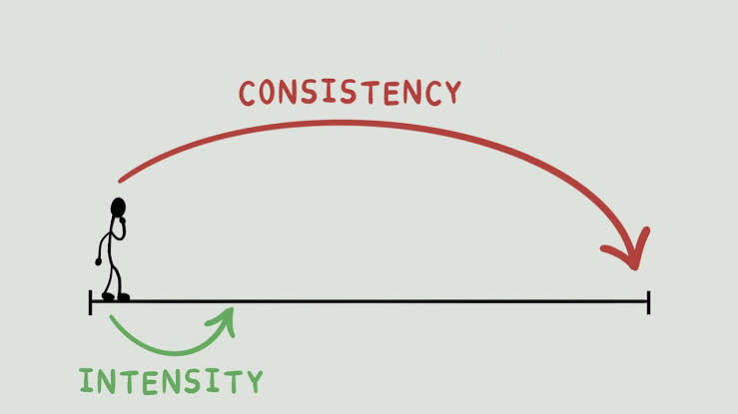
For most beginners, it’s the second person. That’s the heart of this article: for someone starting out, how regularly you move usually matters more than how hard any single session feels. Intensity isn’t useless, and we’ll cover where it helps. But it works best when it sits on top of a routine you can actually keep.
Below, we look at what the research does and doesn’t say, why hard-and-rare tends to fail, and how to build a routine that survives exams, deadlines, family duties, heat and monsoon.
Key takeaways
- Public health guidance is built around a weekly amount of activity, not one heroic workout.
- A large observational study found that people who squeezed their weekly activity into one or two sessions had mortality outcomes similar to people who spread it out, once total activity was equal. Total amount appeared to matter more than the pattern.
- Intensity does count (vigorous minutes are worth more per minute), but it only pays off if you can sustain it and recover from it.
- Habits take longer to form than the popular “21 days” claim suggests, and missing a day here and there doesn’t appear to ruin the process.
- If you have a health condition, are pregnant, or haven’t exercised in a long time, check with a doctor before ramping up intensity.
What “consistency” and “intensity” actually mean
Consistency means how often and how reliably you do something over weeks and months. Intensity means how hard you work during a session: a slow walk is low, a brisk walk is moderate, and running or fast cycling is vigorous.
A simple way to judge effort is the talk test. At moderate intensity you can talk but not sing. At vigorous intensity, you can say only a few words before needing a breath. It’s a rough guide rather than a lab measurement, but it works without a gadget.
What the guidelines actually measure
The World Health Organization’s 2020 guidelines tell adults to aim for 150–300 minutes of moderate-intensity activity, or 75–150 minutes of vigorous activity, or an equivalent mix, each week. They also stress that some activity is better than none, and that adults should do regular muscle-strengthening work, which most guidelines put at two or more days a week.
Notice the unit: minutes per week. The target is a weekly total built up over time. Nothing in it asks for an all-out effort, and nothing rewards a single brutal session followed by a week off.
Intensity does show up in the numbers, though. Vigorous minutes count roughly double moderate ones, which is why the vigorous range is half as long. That’s useful if you’re short on time and already fit. For a beginner, it’s a reason not to dismiss intensity, not a reason to chase it from day one.
Can you cram it all into the weekend?
This is the most honest test of “consistency versus intensity”, because the so-called weekend warrior does the opposite of consistent: one or two big sessions, then nothing.
A 2022 study in JAMA Internal Medicine followed 350,978 US adults whose leisure activity was linked to national death records. After accounting for the total amount of moderate-to-vigorous activity, people who did their recommended weekly dose in one or two sessions had mortality risks similar to those who exercised three or more times a week. Both active groups did better than inactive adults. An earlier analysis of English and Scottish survey data in adults over 40 pointed the same way.
What this tells us, and what it doesn’t:
- It supports total amount over tidy scheduling. If a packed week means your only free time is Saturday and Sunday, that exercise still counts.
- It’s observational. Activity was self-reported, and the studies can’t prove cause and effect. Active people may differ from inactive people in other ways.
- It doesn’t say weekend-only is ideal. A weekend-only pattern asks the body to handle a lot at once, and it’s harder to sustain for a beginner who isn’t conditioned. Most people find several shorter sessions easier on both muscles and motivation.
So the research doesn’t say “never mind when you train.” It says the weekly total is the thing to protect, and how you slice it is flexible.
Why hard-and-rare plans tend to fail
The studies above compare people who actually kept going. The real-life problem for beginners comes earlier: many never reach the point of having a routine at all. Here’s how an intensity-first plan tends to break down.
Soreness and recovery. A sudden jump in effort can leave you stiff for days. If that stiffness makes you skip the next session, the plan has already collapsed. Injury risk also rises when load increases faster than your body can adapt.
All-or-nothing thinking. “If I can’t do the full hour, there’s no point” is a trap. Ten minutes still counts toward the weekly total, and it keeps the routine alive.
Motivation is unreliable. An ambitious plan depends on feeling inspired. A modest plan depends on very little, which is exactly why it holds up on tired, busy, or unmotivated days.
Life isn’t steady. Exams, festival weeks, office deadlines, illness, a broken-down scooter. A routine with some slack bends instead of breaking.
How long does it take to make exercise a habit?
You may have heard it takes 21 days. That number has no solid research behind it. The best-known real-world study, by Phillippa Lally and colleagues at University College London (2010), asked volunteers to repeat one new healthy behaviour daily for 84 days. The median time to reach peak automaticity was 66 days, but individuals ranged from 18 to an estimated 254 days. More complex behaviours took longer, and the study reported that missing a single day didn’t seem to derail the process.
Two caveats keep this honest. The participants chose simple behaviours such as drinking water or eating fruit, and exercise is harder to make automatic. And the 66-day figure comes from the subset of participants whose data fit the model well, so treat it as a rough guide rather than a countdown. A replication effort has been underway, which is another reason not to treat any single number as fixed.
The practical lesson: expect a couple of months of effort, make the behaviour small enough to repeat easily, and don’t read one missed day as failure.
When intensity earns its place
None of this makes hard training pointless. Intensity matters when:
- You’re short on time. Vigorous minutes are worth more, so a brisk 20-minute session can contribute meaningfully to the weekly total.
- You want specific performance goals, such as a faster 5K or heavier lifts. Progress there requires challenge.
- You’ve built a base. After a few months of regular activity, gradually adding harder efforts is more sensible and safer than starting there.
The order matters: routine first, then effort. Raise intensity slowly, for example by walking a little faster or adding a short hill, and keep at least one easy session a week.
A beginner routine you can actually keep
Here’s one realistic template. Treat it as an example and adjust it for your schedule, health, and access to space or equipment.
Weeks 1–2: just show up. Pick three days. Do 10–15 minutes of walking, at a pace where you can chat. Tie it to something you already do, like the walk after dinner or the stretch of road to the bus stop. Linking a new behaviour to an existing cue is the idea behind habit research.
Weeks 3–6: lengthen it. Move toward 20–30 minutes on most days. Add two short strength sessions of about 10 minutes: squats to a chair, wall or knee push-ups, glute bridges, a plank held for as long as is comfortable. No equipment is needed.
Weeks 7 onward: nudge intensity. Walk a bit faster, take stairs instead of the lift, try intervals of one minute brisk and two minutes easy, or add a bicycle ride. Build up only as fast as you recover.
Make it fit real life
- Short on time: three 10-minute bouts spread through the day add up. A brisk stair climb at work or a quick bodyweight circuit counts.
- Heat or monsoon: move indoors with a home routine, walk early morning or after sunset, or use a covered corridor or mall. Drink water, and stop if you feel dizzy.
- Limited budget or space: walking, stairs, bodyweight exercises, or yoga-style movement need no membership.
- Low-energy days: set a minimum, such as five minutes. The aim is to keep the thread unbroken.
- Disrupted weeks: after illness or travel, restart gently at about half your previous load rather than trying to make up for lost time.
Track it simply
A calendar tick or a note on your phone is enough. Count weeks in which you hit your minimum rather than perfect days. This turns “I missed Tuesday” into “I still did four of seven days”, which is more accurate and more motivating.
Common mistakes to avoid
- Starting at your maximum and expecting the effort to last.
- Comparing yourself with someone who has trained for years.
- Treating one missed session as a reset button.
- Skipping strength work entirely. Guidelines recommend it, and it supports everyday tasks like carrying groceries.
- Ignoring pain. Muscle soreness is common; sharp or joint pain is a reason to stop and get advice.
- Ignoring rest. Recovery is part of training, not a break from it.
Limitations and safety
The evidence here is mostly observational, with self-reported activity, and results may differ for different populations and ages. None of it promises weight loss, a particular fitness level, or a set timeline, because individual responses vary widely.
Speak to a doctor or another qualified health professional before increasing intensity if you have heart disease, high blood pressure, diabetes, joint problems, a past injury, or you’re pregnant or recently postpartum, or if you’ve been inactive for a long time. Stop and seek medical help if you experience chest pain, severe breathlessness, fainting, or unusual dizziness during exercise.
This article is general educational information and not a substitute for personalised medical advice.
Frequently asked questions
Is consistency really more important than intensity?
For beginners, usually yes. A moderate routine you keep for months outperforms an intense one you abandon in weeks. Intensity still adds value, particularly for time-pressed people with an established base, but it’s the second step.
Is it okay to exercise only on weekends?
Large observational studies suggest that people who meet the weekly guideline amount in one or two sessions have similar mortality outcomes to people who spread it out. Still, this is not proof of cause and effect, and sudden hard sessions can raise injury risk for people who aren’t conditioned. If a weekend is all you have, ramp up gradually and add short walks on weekdays when you can.
How many days a week should a beginner exercise?
There’s no single right number. Three days of walking plus two short strength sessions is a reasonable starting point, working toward the WHO range of 150–300 minutes of moderate activity per week if your health allows.
What if I miss a day or a week?
One missed day is unlikely to matter, according to the habit research. After a longer break, restart with an easier version rather than doubling up. What counts is returning.
Do short workouts count?
Yes. WHO guidance emphasises that some activity is better than none, and total weekly minutes count. Several 10-minute sessions can add up, though the guideline doesn’t claim every pattern is equal for every goal.
When should I make workouts harder?
After you’ve kept a routine for several weeks and recover well between sessions. Increase one thing at a time, such as pace, duration or resistance, and keep a couple of easy days.
Conclusion
The fittest-looking plan on paper is rarely the one that works. The research points to the weekly total, built up and kept up over months, as the thing that counts, with intensity as a tool you add once the habit is stable.
Two next steps: choose a minimum you could do on your worst day (five or ten minutes), and attach it to something you already do daily. Once it feels ordinary, you can start making it harder.