
Written by Teerth Busa: Health & Fitness Content Writer
Teerth Busa researches exercise, fitness, nutrition, mental well-being, and healthy lifestyle topics using reputable health organizations and scientific sources. His content is written to make health and fitness information simple, practical, and easy to understand.
Best Morning Stretches to Start Your Day
You switch off the alarm, sit up, and your back feels like it belongs to someone twice your age. Or your neck is tight from the way you slept, or your hips complain on the first walk to the bathroom. Many people reach for a quick stretch at this point, and many wonder whether it actually does anything.
The short answer: a few minutes of slow, gentle stretching in the morning is a low-risk way to loosen up and ease into the day, and static stretching does reliably improve how far a joint can move. It is not a cure for stiffness, a shortcut to fitness, or a proven way to prevent injuries. This article gives you a simple routine of about ten minutes, explains how to do each move without hurting yourself, and is honest about what the research does and doesn’t show.
Key takeaways
- Static stretching reliably increases range of motion, meaning how far a joint can comfortably move. That is the best-supported benefit.
- Claims that morning stretching boosts energy, burns fat or “detoxes” the body are not backed by strong evidence. Treat it as a gentle start to the day, not a treatment.
- Mayo Clinic advises about 30 seconds per stretch, no bouncing, and stopping if you feel pain. Easing in with light movement first is sensible.
- Stretching does not replace the aerobic and strength activity recommended by the WHO.
- If you have a recent injury, a spine or joint condition, or you are pregnant, check with a doctor or physiotherapist before starting.
What morning stretching can (and can’t) do
When researchers talk about the effects of stretching, the most consistent finding is about range of motion. A 2023 systematic review of 18 studies on static stretching intensity found that every one of them showed an increase in range of motion after stretching. In everyday terms, regular stretching can help you reach, bend and turn a little more easily.
That is useful, especially if you spend long hours sitting. But it is easy to over-read. Here is what the evidence does not establish:
- Injury prevention. An older systematic review of trials concluded there was moderate to strong evidence that routine static stretching does not reduce overall injury rates, with only preliminary hints that it might reduce certain muscle and tendon injuries. Mayo Clinic describes injury protection as something flexibility “might” provide, which is a fair way to put it.
- Energy, mood or metabolism. Plenty of articles claim morning stretching wakes up the body, improves circulation or helps weight loss. Moving after hours of lying still probably feels pleasant, but we couldn’t find strong evidence for these specific claims, so we won’t make them.
- Replacing exercise. The WHO’s 2020 guidelines recommend 150 to 300 minutes of moderate aerobic activity a week for adults, plus muscle-strengthening activity on at least two days. Stretching can sit alongside that, not instead of it.
Think of morning stretching as a cheap, comfortable habit with a solid, modest benefit: it helps joints and muscles move more freely, and it gives you a few unhurried minutes before the day gets busy.
Before you start: a few rules that matter
Ease in rather than yanking yourself out of bed. Mayo Clinic recommends warming up with five to ten minutes of light activity before stretching, and notes that stretching after exercise, when muscles are warm, is usually best. First thing in the morning your body is cold, so the routine below starts with small movements lying down and builds gradually. If you can fit in a short walk first, even better.
Hold, don’t bounce. Mayo Clinic suggests holding each stretch for about 30 seconds and keeping the movement slow. Bouncing is discouraged. If 30 seconds feels long at first, start with 15 to 20 seconds and build up.
Mild tension is fine; pain is not. You should feel a gentle pull. Mayo Clinic’s guidance is that pain means you’ve gone too far, so back off.
Keep breathing. Holding your breath tends to tighten you up. Slow breaths in and out through the nose work well.
Don’t push for the “perfect” shape. Your body on a given morning decides how far you go. Flexibility differs from person to person and from day to day, so compare yourself only with yesterday.
A 10-minute morning stretches routine
You need a few square feet of floor, a mat or folded blanket, and a wall. Do the first three moves in bed if the floor is cold or hard. Aim to hold each stretch for 20 to 30 seconds, doing both sides where relevant.
Part 1: Wake up the body (about 3 minutes)
1. Full-body reach. Lie on your back and stretch your arms overhead and your legs long, as if someone were gently pulling you from both ends. Hold for a few breaths, relax, and repeat two or three times. This is the closest thing to the natural yawn-and-stretch most of us do anyway.
2. Knee-to-chest. Still on your back, hug one knee towards your chest and keep the other leg resting long or with the knee bent. Hold about 30 seconds, then switch. Mayo Clinic includes this stretch for the lower back. Go gently if your back is sore.
3. Knees-over twist. Bend both knees with feet flat, arms out to the sides. Let both knees drop slowly to one side while your shoulders stay on the floor. Hold, return to centre, then switch sides. Move only as far as feels comfortable.
Part 2: Back, shoulders and neck (about 3 minutes)
4. Cat-cow. Come onto hands and knees. Breathe in as you let your belly drop and your chest lift, and breathe out as you round your back towards the ceiling. Do eight to ten slow cycles. This is a moving stretch rather than a held one, so it also works as a warm-up for what follows. Place a folded blanket under your knees if the floor bothers them.
5. Child’s pose. From hands and knees, sit your hips back towards your heels and rest your forehead on the floor or a cushion, arms stretched forward or resting by your sides. Stay for 30 seconds or more, breathing slowly. If your knees complain, put a pillow between your calves and thighs, or skip this one.
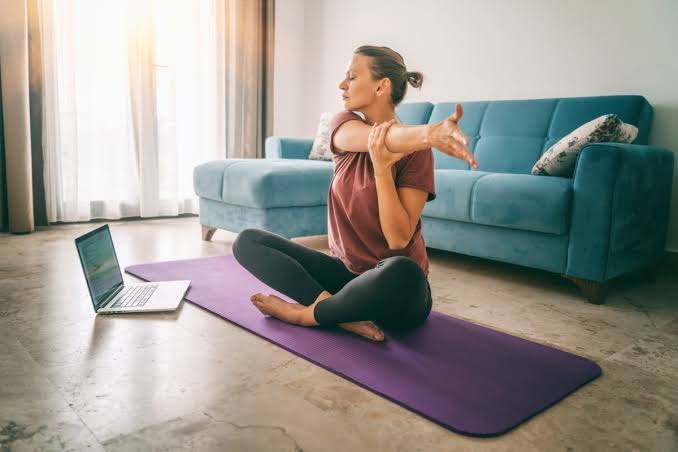
6. Cross-body shoulder stretch. Sitting or standing, bring one arm across your chest and hold it just above or below the elbow, as Mayo Clinic describes. Hold about 30 seconds and switch. This one is helpful if you’ve been bent over a phone or laptop.
7. Gentle neck tilt. Sit tall and let your right ear drift towards your right shoulder without lifting the shoulder. Hold 15 to 20 seconds, then switch. Keep it light. The neck is delicate, so don’t pull on your head with your hand, and stop at once if you feel tingling, numbness or sharp pain.
Part 3: Hips and legs (about 4 minutes)
8. Standing calf stretch. Place your hands on a wall, step one foot back, keep that heel down and bend the front knee slightly. Hold about 30 seconds each side. Tight calves are common if you wear heels or spend a lot of time on a scooter or bike.
9. Hamstring stretch. Sit on the edge of a chair or on the floor with one leg stretched out and the other bent, and lean forward from the hips with a long back until you feel a pull behind the thigh. Hold about 30 seconds per side. Don’t round your back to reach your toes. Your reach is less important than the feel of the stretch.
10. Standing quad stretch. Hold a wall or chair for balance, bend one knee and gently draw the heel towards your buttock, keeping your knees close together. Mayo Clinic describes pulling the heel up and back until you feel a stretch in the front of the thigh. Hold about 30 seconds each side.
11. Low lunge hip stretch. Step into a lunge with the back knee on a cushion, and gently shift your hips forward until you feel the front of the back-leg hip open up. Hold about 30 seconds per side. This one targets the hip flexors, which can feel tight after long periods of sitting.
If ten minutes feels like too much, pick four or five stretches: the full-body reach, cat-cow, a shoulder stretch and a calf or hamstring stretch cover most of the body in under five minutes.
Making it fit real life
A routine only helps if it survives a normal week. A few adjustments for common situations:
Short on time. Five minutes beats nothing. Do the stretches while the tea or coffee is brewing, or before your bath.
Cold mornings. In winter, stay under a blanket for the first three moves, and keep a light layer on. Cold muscles feel stiffer, so don’t judge your flexibility on a chilly morning.
No floor space or you can’t get down easily. Almost everything above can be adapted to a sturdy chair. Seated hamstring stretches, seated twists, shoulder and neck stretches and a standing calf stretch at the wall all work without getting onto the floor.
Early commuters. If you have to leave in a rush, stretch in the evening instead, or do two or three moves at your workplace. Morning is a convenient time, not a magical one. We found no evidence that stretching at a particular hour matters more than doing it regularly.
Yoga-style movements. Cat-cow and child’s pose come from yoga, and if you already practise yoga you can swap in familiar poses. Just keep the same rules: slow, comfortable, no pain.
Consistency over intensity. Mayo Clinic suggests that people who don’t exercise regularly could stretch a few times a week after a brief warm-up. You don’t have to do it daily. Three or four mornings a week is a reasonable start, and you can build up if you enjoy it.
Static or dynamic? A quick guide
The routine above mixes two types of stretching. Static stretching means holding a position. Dynamic stretching means moving through a range, like cat-cow or arm circles.
You may have heard that static stretching before exercise weakens your muscles. A 2019 review in Frontiers in Physiology found that short stretches of 60 seconds or less per muscle have only trivial effects on strength and power, while longer holds show larger drops. For a casual morning routine, where you aren’t about to sprint or lift heavy, this is not a serious concern, and keeping holds to 30 seconds or so sidesteps it.
If you are heading straight into a workout or a sport afterwards, favour gentle movement-based stretches and a proper warm-up, and save the longer holds for after exercise.
Common mistakes
- Stretching cold and going deep. Start gently and increase gradually.
- Bouncing. It is discouraged because it can push you past a comfortable range.
- Forcing the stretch through pain. Pain is a signal to ease off.
- Holding your breath. Keep your breathing slow and steady.
- Only stretching tight muscles. Mayo Clinic notes that stretching also helps keep flexibility similar on both sides of the body, so check both sides.
- Expecting quick change. Flexibility improves gradually, and the day-to-day feel of looseness may be the main thing you notice first.
Who should be careful
Morning stretching is generally gentle, but it isn’t right for everyone in every circumstance. Speak with a doctor or physiotherapist before starting if you:
- have a recent injury, a sprain, strain or fracture;
- have a diagnosed back, neck or joint condition, osteoporosis, or have had joint surgery;
- are pregnant or recently gave birth (the WHO lists stretching among suitable activities for pregnancy, but individual advice matters);
- have numbness, tingling or pain that travels down an arm or leg;
- feel dizzy when you stand up or have heart or blood pressure concerns.
If stiffness is severe, lasts well beyond the first hour of the day, comes with swelling or redness in a joint, or keeps getting worse, don’t just stretch it. See a doctor. This article is general education, not personal medical advice.
Frequently asked questions
Is it better to stretch in the morning or at night?
Neither time has been shown to be better. What matters is that you do it regularly and gently. Many people find mornings suit them because stiffness is most noticeable then. Others prefer evenings, when muscles are warmer, which fits Mayo Clinic’s advice to stretch after muscles are warmed up.
How long should I hold each stretch?
About 30 seconds is the usual advice from Mayo Clinic, and beginners can start with 15 to 20 seconds. The 2019 review mentioned above suggests holds of 60 seconds or less per muscle have only a trivial effect on strength and power, so there’s no need to hold much longer.
Can morning stretches help with back pain?
They may bring comfort to some people, and Mayo Clinic includes the knee-to-chest stretch for the lower back. But back pain has many causes, and a simple routine is not a treatment. If pain is severe, persistent, follows an injury, or comes with leg weakness or numbness, get it checked.
Do I need to warm up before stretching in the morning?
A little. Mayo Clinic recommends five to ten minutes of light activity before stretching. A short walk is ideal, and the lying-down moves and cat-cow in the routine above serve as a gentle warm-up if you can’t walk first.
Will stretching make me lose weight?
Not in any meaningful way. Stretching uses little energy and isn’t a weight-loss method. If that’s your goal, the WHO’s aerobic and strength guidelines, along with your overall eating pattern, are where the real effect lies.
How soon will I feel a difference?
It varies. Some people feel looser straight after a session. Lasting changes in flexibility take weeks of regular practice, and we can’t promise a timeline.
Conclusion
Morning stretches are a modest habit with a clear, evidence-supported benefit: better range of motion, and a calm few minutes before the day starts. They won’t prevent every injury, melt fat or replace exercise, and that’s fine.
If you want to begin, choose four or five stretches from the routine, hold each for about 30 seconds, keep it comfortable, and do it three or four mornings this week. Pair it with regular walking or other activity, and see a professional if something hurts, or you’ve got a condition that needs tailored advice.